The Psychology of Money
Money Isn’t Just Math.
When we talk about money, we tend to talk about numbers.
How much do you earn? How much have you saved? What do you owe? What rate of return are you getting? How much will you need for retirement?
Those numbers matter. Of course they do.
But after more than 35 years working in financial services and financial education, I’ve become convinced that some of our most important financial decisions aren’t really about the numbers at all.
They’re about what those numbers mean to us.
Your Money Story Started Long Before Your First Paycheck
Before I began my career in finance, I was interested in psychology. Looking back, that seems almost prophetic.
Our experiences teach us what money means long before most of us understand interest rates, investments or retirement plans.
We learn whether money feels plentiful or scarce. Whether talking about it feels comfortable or frightening. Whether having more of it represents success, freedom, power, generosity—or simply the ability to sleep at night.
Those experiences don’t disappear when we become adults and start making “rational” financial decisions.
We bring them with us.
What Are We Really Searching For?
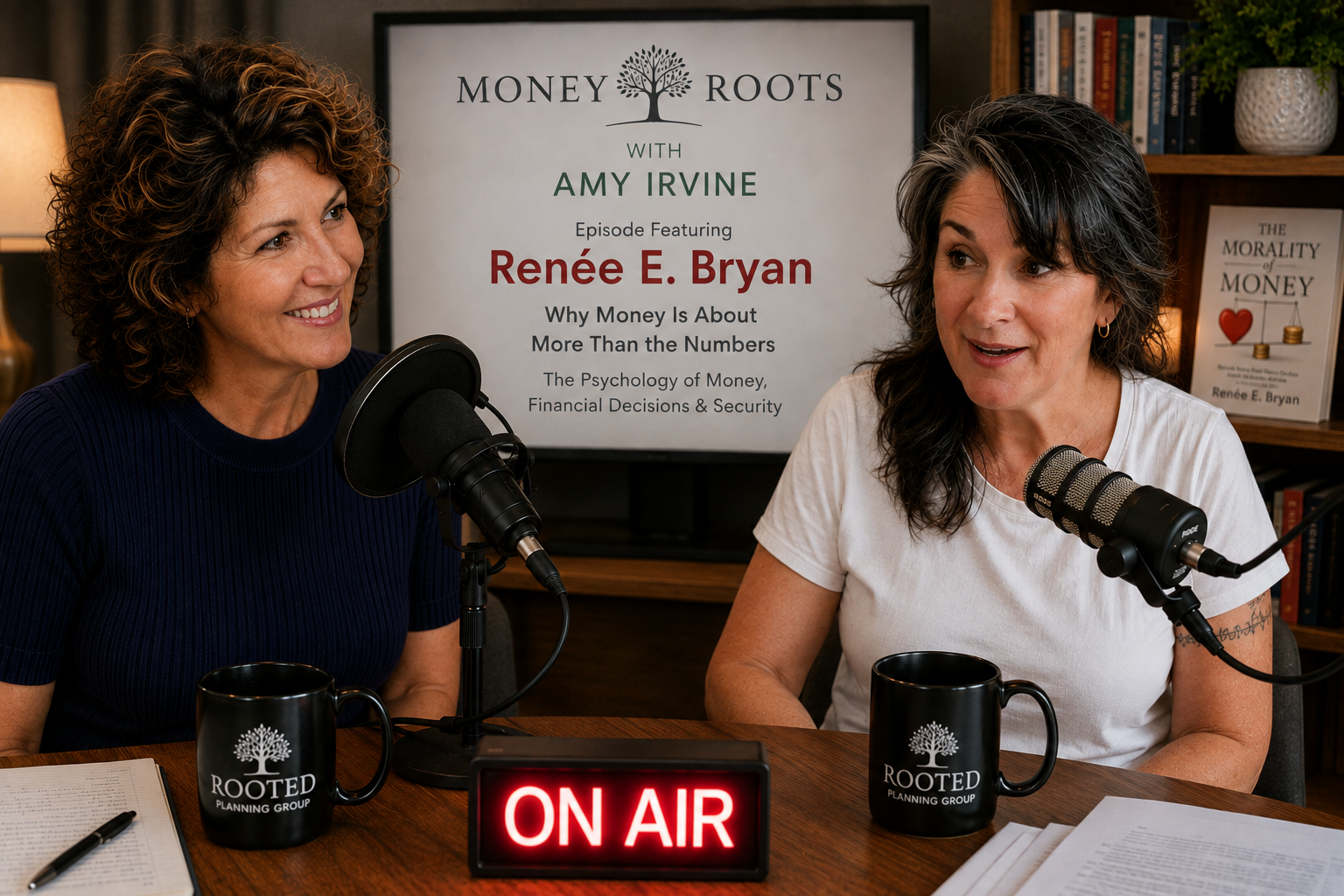
I recently joined financial planner Amy Irvine on the Money Roots podcast, and our conversation kept returning to one idea:
What they’re really searching for is security.
That security looks different for everyone.
For one person, it might mean having six months of expenses sitting safely in the bank. Someone else might feel perfectly comfortable with considerably less.
One person may see a mortgage as stability and ownership. Another may see that same mortgage as an enormous obligation.
Even wealth itself doesn’t automatically eliminate financial fear. You can have millions of dollars and still be afraid of something financial.
That’s because a bank balance and a feeling of security aren’t necessarily the same thing.
Fear is one particularly powerful part of our financial psychology. I explored that more deeply after another recent podcast conversation in How Fear Affects Financial Decisions .

Amy Irvine and the team at Rooted Planning Group
Understanding the Psychology Behind the Decision
This doesn’t mean the numbers don’t matter.
Quite the opposite.
We need financial knowledge. We need to understand how investments, insurance, debt, taxes, Social Security, Medicare and other financial tools actually work.
But knowing how a tool works isn’t the same as knowing whether it’s the right tool for you.
That’s where understanding ourselves becomes important.
Why am I making this decision?
What am I afraid will happen?
What am I hoping money will provide?
Is this decision helping me create the life I actually want—or am I following a financial rule someone else handed me?
Those questions belong in financial planning too.
Your Financial Plan Should Be More Like Play-Doh
During my conversation with Amy, I described a financial plan as squishy—like Play-Doh.
I meant it.
Life changes.
And sometimes we change.
A financial strategy that made perfect sense at 35 may make absolutely no sense at 55.
That’s why I don’t believe financial planning should be about finding one perfect formula and following it forever.
It should be about understanding the tools well enough to use them when they’re useful—and understanding yourself well enough to recognize when it’s time to change the plan.
Money Doesn’t Exist in a Vacuum
There’s another part of our financial lives that we sometimes overlook.
We don’t make financial decisions in isolation.
YOUR MONEY
Interest rates, inflation, taxes, health care costs, government programs, economic policy and broader economic conditions all affect the choices available to us.
That’s one reason I’ve always believed financial education needs to go further than teaching people how to create a budget.
Understanding why something is happening can make the financial world considerably less frightening.
And understanding ourselves can help us decide what to do about it.
Money Roots Podcast
Why Money Is About More Than the Numbers
Amy Irvine and I talked about the psychology of money, financial security, fear, financial planning, economics, government programs, health care—and why understanding the bigger picture matters when we’re making decisions about our own money.
LISTEN TO THE CONVERSATIONThat’s the Psychology—and the Morality—of Money
This intersection between money, psychology, economics, fear, security, values and the lives we’re trying to create became an important part of The Morality of Money.
The book isn’t about accumulating the largest possible pile of money.
It’s about understanding money well enough that it can become a tool rather than something that controls our decisions through fear.
Because financial freedom isn’t simply a number.
It’s understanding what enough means for you—and creating a financial foundation that supports the life you actually want to live.
Continue the Conversation
The Morality of Money
Explore how our financial decisions intersect with economics, fear, security, values, faith and purpose—and how understanding those connections can help us create greater financial freedom.
EXPLORE THE BOOK MORE FROM RENÉE

Comments are closed